The Aesthetic Detective: Decoding Facial Bumps
Not every bump is a pimple
Most people have one working theory about a bump on the face, which is that it is a pimple, and one plan, which is to squeeze it. That theory is wrong more often than it is right. The small bumps that sit on cheeks, eyelids and foreheads are usually one of four different things, and they are not variations on the same problem. They form in different layers of the skin, they are made of different material, and they respond to completely different treatment. Squeezing helps almost none of them, and on some of them it does real harm.
Here is what is actually there, and how they are told apart.
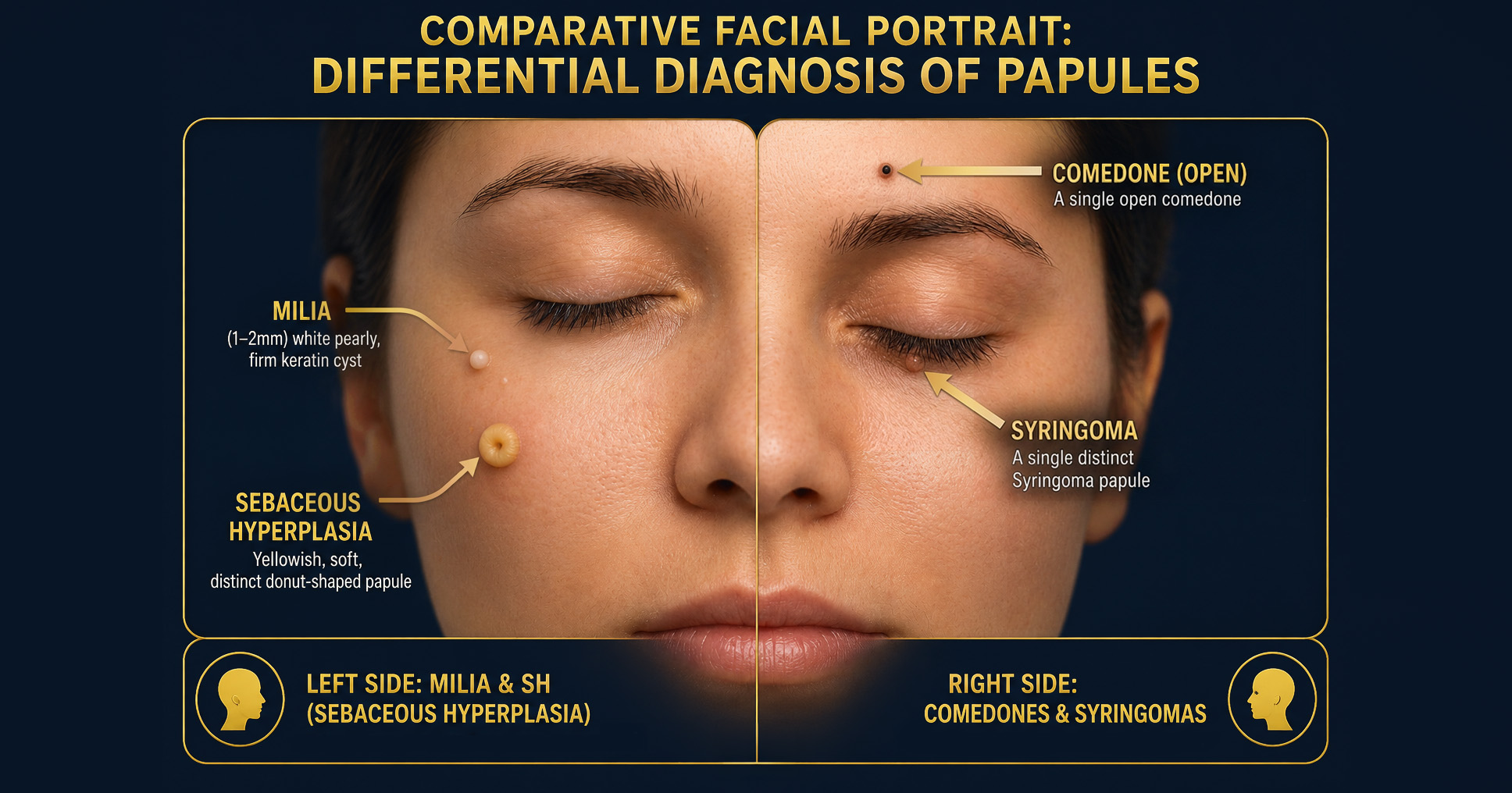
Milia: the skin pears
Milia are tiny cysts sitting just under the surface of the skin. Each one is a sealed pocket of keratin, the protein skin is built from, with no opening to the surface at all.
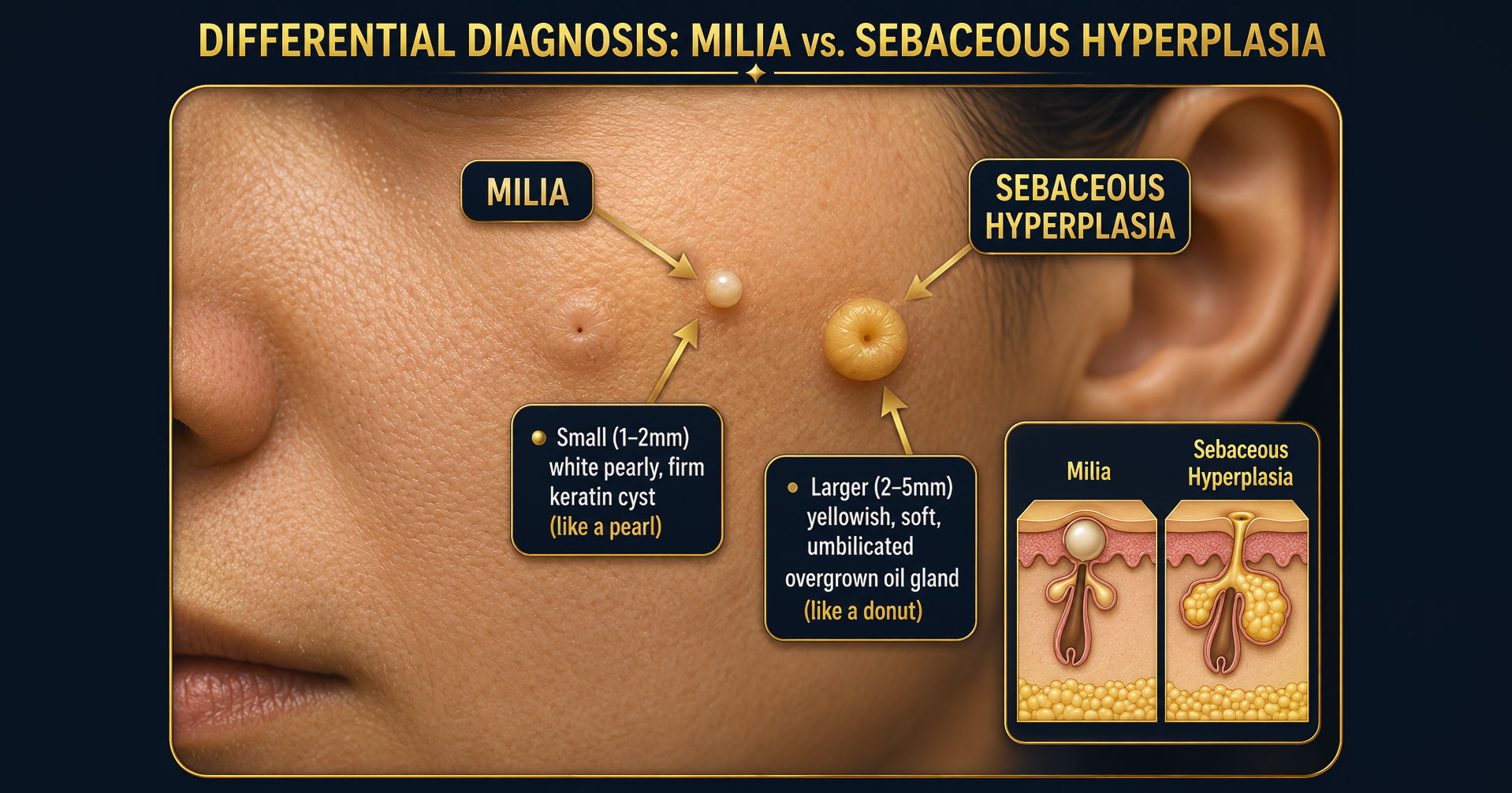
What it looks like. One to two millimetres across, perfectly round, firm, and bright white or pearly. There is no visible pore, and that is the giveaway. A whitehead has an opening. A milium does not.
Why it happens. Dead skin cells get trapped instead of shedding. Some people simply form them. Others develop them after a burn, a blistering rash, or long use of heavy occlusive creams, which is part of why they cluster around the eyes, where thick creams tend to get applied.
Because a milium is walled off with no opening, squeezing achieves nothing. There is nowhere for the contents to go. Pressure hard enough to matter will bruise the skin and can leave a mark that outlasts the bump.
Sebaceous hyperplasia: the oil donuts
This one is not trapped debris at all. It is a living oil gland that has enlarged and pushed up toward the surface.
What it looks like. Two to five millimetres, soft, yellowish or skin coloured, with a small dip in the centre. That central dimple is the mouth of the follicle the gland empties into, and it is the most useful single sign for separating these from milia. Milia look like pearls. These look like donuts.
Why it happens. Genetics, accumulated sun damage, and the hormonal shifts that come with age. As skin turnover slows, the gland swells rather than draining cleanly.
Squeezing one produces a drop of clear oil and a bruise. The gland is still there the next morning, because the gland is the lesion.
Comedones: the actual clogged pores
These are the only ones on the list that are genuinely acne. A comedone is a follicle plugged with a mixture of oil and dead skin cells.
Closed comedone, the whitehead. The follicle is sealed over, so the plug sits trapped just below the surface as a small white or skin coloured bump.
Open comedone, the blackhead. The same plug, but the pore is stretched open and the exposed surface of the plug has oxidized in the air. The dark colour is not dirt, and no amount of scrubbing will wash it out.
Why it happens. Hormones, oil production, skin cells that do not shed properly, and pore clogging makeup and skincare.
Syringomas: the one that fools people
Around the eyes there is a fourth possibility that gets mistaken for milia constantly.
What it looks like. Clusters of small firm bumps, one to three millimetres, skin coloured or faintly yellow, almost always on the lower eyelids and upper cheeks. They arrive in groups rather than singly, and they stay.
Why it happens. They are benign growths of the sweat glands, driven mainly by genetics. They tend to appear in early adulthood and are more common in women.
Like sebaceous hyperplasia, there is nothing inside to extract, which is why they survive every attempt to squeeze them out.

Why the squeeze is the wrong instinct
Of the four, only comedones contain something that can actually come out, and even those release cleanly only when the follicle is open and the pressure is applied correctly. The other three have nothing to release. What squeezing reliably produces across all of them is inflammation, broken capillaries, and a brown mark where the bump used to be. That post inflammatory pigmentation can take months to settle, and on some skin it does not fully clear. The bump was a cosmetic nuisance. The mark left behind is often the larger problem.
The bump that does not stay put
One caution, because not every small firm bump belongs on this list. A few skin cancers begin as an unremarkable bump that looks entirely harmless in its first month. What separates them is not how they look on day one, it is how they behave over time. A bump that slowly grows, changes shape or colour, bleeds, or scabs over and reopens without ever healing needs a proper look rather than a cosmetic treatment. I go through those warning signs in The Truth About Brown Spots.
What treatment actually involves
These four are treated in four different ways, and the right one depends entirely on which lesion it is. Milia are opened and cleared. Comedones are managed largely through skincare that corrects how the follicle sheds, with clinical clearing where it is needed. Sebaceous hyperplasia and syringomas are glandular tissue, so they are addressed by treating the gland itself rather than by extraction.
Some of that is done in this clinic and some of it is not. A few of these are better handled by a dermatologist, and where that is what the skin needs, that is what you will be told. What matters more than the technique is that the lesion is identified correctly first, because the treatment that clears one of these will do nothing at all for another.
The bottom line
A bump on the face is a description, not a diagnosis. Four common things look nearly identical in a bathroom mirror and separate readily under proper light and magnification. So the useful first step is not a treatment. It is an assessment: confirming which of these it is, ruling out the rare one that does not belong on the list, and only then deciding what, if anything, should be done about it.