Now We Know
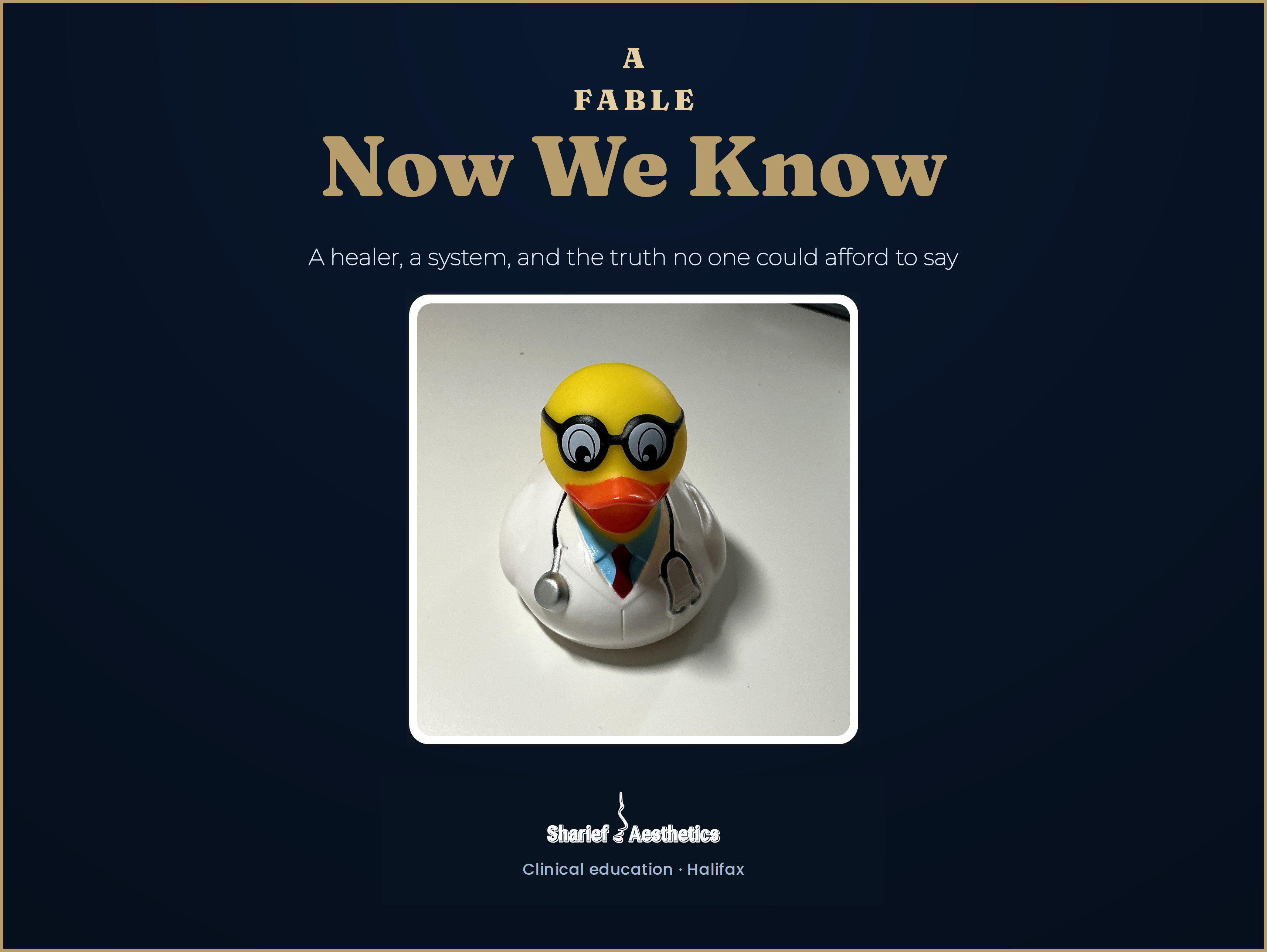
The Tale of Dr. Oky Duckie: A Fable of the Great Ponds
Once upon a time, in a faraway land of ponds and reeds, there lived a duck named Dr. Oky Duckie, who was a doctor.
He was a good doctor. In his small village, he knew every duck by name: which ducklings had weak chests in winter, which old drakes forgot their medicine, which mothers worried too much, and which not enough. He set their bones and sat with them when there was nothing left to set. The village loved him, and he loved the village.
But he was restless. He would look at the horizon some evenings and think:
“I have two good hands and a good mind, and a village this small only needs so much of them. In the crowded places, I could help more ducks. Surely that is the better use of a life.”
So, he went to the great hospitals in the cities.
The Original Promise
And for a long time, it was good. The land had built something fine. Every duck who came was seen. The most broken were rushed in first; the ones who could wait, waited, but not too long. When a hospital could not give a duck what he needed, it sent him onward to a bigger one that could.
It was not perfect, but it was honest. It was built by ducks who understood ducks: healers who had set bones and sat with the dying and knew, in their feathers, what care was for.
Every duck in the land paid for it, gladly, in their taxes and their fees, year after year, because in return any duck who fell ill would be caught. That was the promise. That was the whole point.
The Straining of the Arithmetic
Dr. Duckie grew older. He became a senior duck himself, his feathers gone grey at the edges, and as he aged, he began to notice something that did not sit right.
The land was filling with ducks, more every season. But the hospitals did not grow, and the number of duck-doctors did not grow, and the arithmetic stopped making sense to him. More ducks, more illness, the same few hands. He could feel the promise straining.
So he asked the ducks in charge: “Why does nothing change? Why, with so many more of us, do we build no more?”
“Oh, do not worry,” they told him. “We have a senior team of very wise ducks who plan the future. It is all in hand.”
And Dr. Duckie turned that answer over in his mind, and a question rose in him that he could not put down: Can the seniors plan a future they will not live to see? And whose future are they planning—their own, or all the ducks’?
The Table
They heard him ask it. And rather than turn him away, they did something cleverer: they invited him to the table. “Come,” they said. “Sit with us. See for yourself how it is done.”
He went. He sat at the table. And it took him two meetings to understand.
The table was not run by ducks who understood ducks anymore. It was run like a company, like an arm of the government itself. The decisions were not medicine; they were politics. The questions were never which ducks are suffering, and how do we reach them? They were:
- Which ponds vote?
- Which ducks pay the most?
- Which complaints are loudest this season?
Care flowed not to where the need was greatest, but to where the voices were richest.
So he went back through the records himself, and counted. Three times the land had tried the other way, letting the small villages keep their own clinics. Three times it had worked—closer, quicker, the care that reached a duck before he broke. And three times the pendulum was hauled back to the great ponds.
Not because the small clinics had failed. Because they had not. The ones who ran the great ponds did not like a competitor, and liked it least of all when the small one won. So the better answer was buried, again and again, for the crime of working.
The Old Hand
There was a duck who sat beside him at that table, an old hand who had held his chair through every ruler the land had ever known. He had kept it by learning each new ruler’s wishes faster than anyone, agreeing most warmly, and never once being the duck who said the difficult thing. He was not a wicked duck. He was a surviving one—which the pond rewarded far better than it rewarded a good one.
He leaned close to Dr. Duckie now and said, gently, as a friend would:
“Save your feathers. Sit still, say nothing, and you will be fine. Speak, and you know how the dinners in this land are served.”
And Dr. Duckie said the thing they did not like.
“We do not have enough doctors because we chose to make it this way. We could have made more. We decided not to.”
He said more, because once a duck starts telling the truth at a table like that, it is hard to stop. He told them their plan was no plan. He told them the pond was being filled faster than they would admit, and on purpose, to keep the great businesses cheap; and that the promise—any duck who falls ill will be caught—had never been made bigger to match.
The Unspoken Future
And then Dr. Duckie understood the whole of it, all at once, the way you understand a diagnosis you have been circling for months.
The system was old. Like him. Like anything that has lived past its time. It was on life support, and everyone at the table knew it, and no one would say it. One day—not yet, but one day—the ducks in charge would decide quietly to let it go: to pull the plug on the old promise and begin something new in its place.
He sat with what that would mean for the ordinary ducks of the land. The ducklings with weak chests. The old drakes who forgot their medicine. The mothers who worried.
He saw that the ducks in charge already had their answer ready, and that it was, in its way, perfect:
“Why does a duck even need a doctor? Others can do most of it. And going to see one—that is old-fashioned, is it not? A waste of a journey. Far better a call upon a screen, a voice through a wire. We will save them the trouble of the drive.”
And for the ducks who are truly suffering, the new thinking went, gentlest of all, for the ones in real and final discomfort—well. We can send someone to them. Someone kind. To give them their comfort. To give them mercy.
Afterward
Dr. Duckie sat very still.
He went home. And because he was who he was—a duck who could not hold a truth without saying it—he told his friends what he had seen at the table, and what he believed was coming.
As for the smooth duck who had told him to save his feathers, he did exactly as he had always done. He said nothing that ever cost him anything. And he rose. He became a chief, then a keeper of one of the great ponds, and in time he came to sit at the very head of the table and rule. The pond does not eat that kind of duck. It feeds him, and it lifts him, and it calls him wise.
The friends listened.
And not long after, at a fine dinner in one of the great ponds, a dish was served that the guests all agreed was very good.
It was orange duck.
The duck at the head of the table said it was the finest he had tasted in years.