The Truth About the Nefertiti Neck Lift
She’d had it done eight months earlier, at a clinic two provinces over, and she wanted me to look at her neck before she committed to anything else. “The Nefertiti thing,” she called it, because that’s what the consult room had called it too. She’d bought into the name as much as the syringe — somewhere in the pitch, someone had mentioned Nefertiti’s long, sculpted neck, and she’d pictured exactly that. What she got instead was a slightly less tired-looking jaw for about six weeks. After that, her actual concern — the jowl she’d come in for in the first place — was sitting exactly where it had always been.
She wasn’t imagining it. Technically, nothing had gone wrong with the injection itself. She’d simply been sold a queen’s neck using a treatment that was never built to deliver one.

“Nefertiti didn’t have a neurotoxin. She had thirty-three centuries of legend and a sculptor good enough to make her the most recognizable face in Egyptology. What’s borrowing her name today is a few units of toxin along the jaw — and it will not turn anyone into a queen. It will, reliably, buy the injector a nice dinner.”
Four Layers, One Target
Here’s what I actually showed her.

Four layers, in this order from the surface down: skin, a pad of fat, the platysma muscle, and beneath that, the mandibular retaining ligament — the fibrous structure anchoring soft tissue to bone. Toxin works on exactly one of these four. It relaxes muscle. That’s its entire job description, and it does that job well.
What toxin cannot do is touch the other three. It cannot tighten a ligament that’s loosened with age — the actual structure responsible for tissue no longer sitting where it used to. It cannot lift a fat pad back up once it’s descended. And it obviously has no effect on skin that’s lost its own elastic snap.
Two Necks, the Same Injection
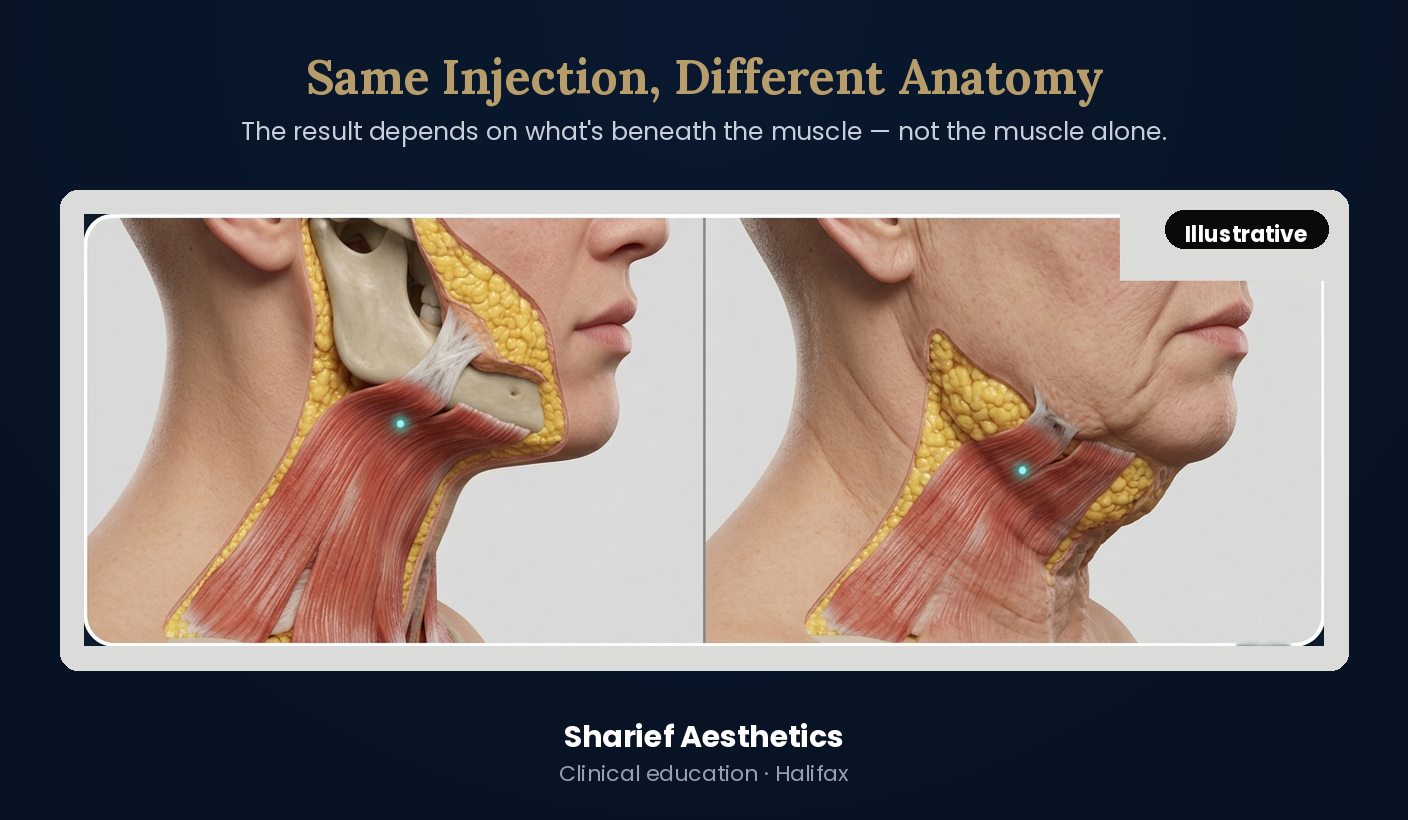
On the left: a young, thin neck. Minimal fat, a tight ligament, an early muscular band and nothing else going on yet. Weaken that band with toxin, and the muscles working against it get a real, if temporary, advantage. For that patient, this is close to correct medicine.
On the right is her. Established fat descent. A ligament already loosened. The same small injection sits in exactly the same spot — but beside a fat pad and a stretched ligament that dwarf the muscle’s influence entirely. The muscle was never the primary cause of her jowl. The neuromodulator was never going to be the correction, injected flawlessly or not.
What the Technique Actually Treats
The honest verdict on this technique, done properly, at the full sixteen-to-twenty-four-point protocol: it’s real physiology, correctly applied, for platysmal banding. Somewhere along the way, marketing borrowed a queen’s name and quietly changed what the treatment was being sold to fix.
Why the Familiar Syringe Keeps Winning
When neuromodulators first arrived in aesthetic medicine, they were close enough to magic — a genuinely new way to soften a moving line that nothing before it could touch. That made sense for that era. It doesn’t mean every structural problem since has been handed the same syringe just because the syringe is familiar. Times have changed. Subdermal radiofrequency and RF microneedling now work on the skin and its support structure directly — the actual problem, not the muscle sitting beside it. Neither is sold as quickly, or for as few tokens, as a treatment that borrows a famous name and hopes no one asks what the needle is actually reaching.
She didn’t need a doctor to tell her what she now knew. She just needed to know it — and whatever she decided next would be a far more informed decision than the one that had brought her here in the first place.
At Sharief Aesthetics, we’d rather tell you why we’ve made a call than simply say no and leave it there. This is one of those calls.