The Truth About Refractory Integrity Syndrome
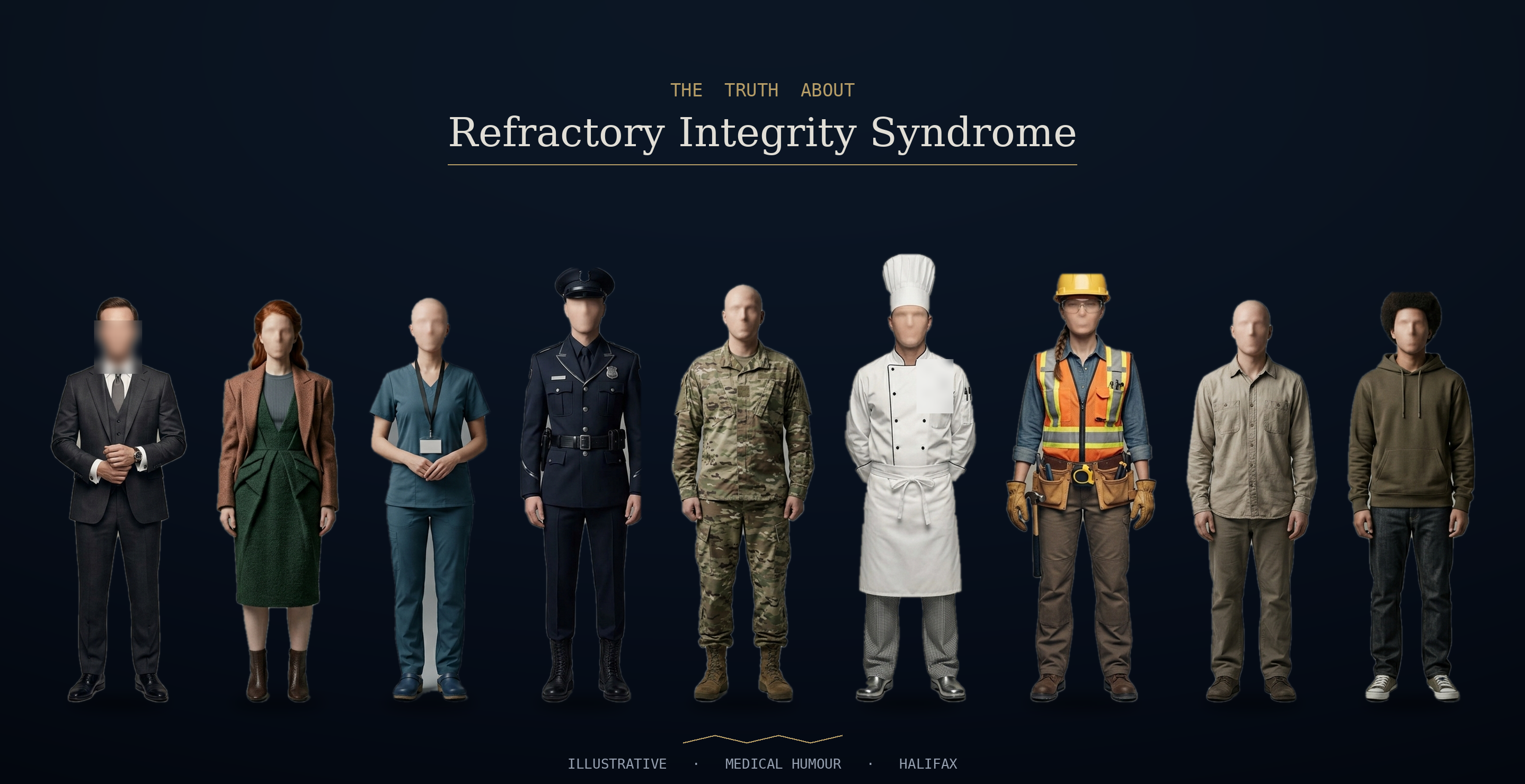
A case report. Patient details altered. The condition is not.
Diagnosis: Refractory Integrity Syndrome. Formerly catalogued as Honest Person Disorder, integrity-resistant subtype. Autosomal dominant. Comorbid with Moral Integrity Disorder and a chronic, untreatable case of meaning what one says.
I have examined the patient thoroughly. I am writing this chart to be honest about what I found, which is fitting, because honesty is the presenting problem, and there is nothing I can offer to fix it.
Presenting complaint
The patient, a man in his middle years, was referred for an inability to lower his standards to meet the conditions around him. He had assumed, reasonably, that this was a treatable defect. He arrived expecting a prescription. I had to tell him there is no prescription, and that the friction he feels is not the illness. The friction is the diagnosis confirming itself.
History of the condition
Onset was early, which is typical. The patient was raised to believe that a thing done is a thing done properly, that a person’s word is collateral, and that you treat the stranger in front of you the way you would treat your own family, because no second, lesser standard is held in reserve for people you owe nothing. These beliefs were installed before he had the judgment to refuse them. By the time he understood they would cost him, they had become load-bearing. Removal was no longer possible without collapse.
Family history
This is the part the patient least wanted to hear. The condition is autosomal dominant. A single copy from a single affected parent is sufficient to express it, which is how it came to him, down a line of people who were the same way and paid for it the same way. It does not skip. Each of the patient’s children carries a one-in-two chance of inheriting the full syndrome, and a higher chance still of the milder carrier state, in which a person knows exactly what is right, says it less often, and feels the cost every time they stay quiet. The patient was informed of these odds. He was asked, gently, whether he had taken any steps to spare his children. He had not. He said he would not. He appeared, if anything, to hope they would inherit it. I noted this in the chart. It is among the most reliable signs of the disorder, and it does not respond to counseling.
Clinical presentation
The condition is most disabling wherever a transaction is involved. The patient is constitutionally unable to recommend a thing a person does not need. He has been observed telling someone who came to buy something that the thing they want is the wrong thing, and that he will not provide it. He will, unprompted, name the limits of his own tools, and tell a person when the expensive option in front of him is the wrong choice for them. No one asked him to. No one paid him to. He does it because the alternative is to lie by saying nothing, and the condition forbids the silence as much as the lie. This behavior has no market logic and the patient cannot stop.
Differential diagnosis
Several explanations were considered and ruled out. This is necessary, because across history the same trait has been filed under whatever label the era found most convenient. It has been called heresy, when the era ran on doctrine. Madness, when the era ran on conformity. Naivety, when the era ran on leverage. Today it is most often filed as arrogance, narcissism, self-righteousness, or delusion, because those are the boxes our era reaches for first. The labels change every century. The patient does not. That is the clue.
Not arrogance. Arrogance exempts itself from scrutiny. The patient invites scrutiny and changes his mind when shown he is wrong. The standard is his master, not his ego.
Not narcissism. The narcissist needs to be seen. This patient behaves identically when no one is watching, which is the only real test of the trait, and the cruelest, because it pays nothing.
Not naivety. The patient knows precisely what the easy path looks like and how to take it. He declines with full information. A naive man does not know the price. This one knows it to the dollar and pays it anyway.
Not delusion. A delusion is a false belief held against the evidence. The patient’s beliefs are not false. They have simply become unfashionable, and our era has started treating “unfashionable” and “untrue” as the same word. They are not the same word. This is, in fact, the core of the patient’s problem, and arguably of ours.
Cardinal feature
What separates this condition from ordinary professionalism is its refusal to switch off when switching off would be profitable and undetectable. Most people keep a standard for public view and a quieter discount for private use. The patient has only the one. He applies it identically to the institution that harasses him, the merchant who overcharges him, the customer who can afford everything, and the customer who can afford nothing. He cannot locate the second standard. He has looked for it. It is not there.
Prognosis
Poor. The condition will not resolve, and I will not pretend otherwise to comfort him. He will continue to lose, in the narrow currency the age keeps score in, to people unburdened by the trait. He will continue to be told that the world has moved on and that he should move with it. There is no version of this man who is both cured and still himself. The cure would require removing the thing that makes him worth curing, which is not medicine. It is amputation.
A note on the era, since the patient kept raising it
He asked, more than once, whether the problem might be him. Whether he could be made fit for the times. This is the diagnostic inversion the condition produces under pressure: the patient concludes that because the age does not reward the trait, the trait must be the malfunction. It is the wrong way around. There was a time, and not a distant one, when none of what this man does was called a disorder. It was simply called being a decent person, and it was expected, not diagnosed. That these traits now present as a syndrome says less about the patient than about the room we are all standing in. The age did not just grow more cynical. It made moral clarity itself look like an act of aggression, and shrank the space in which a person may plainly say “this is wrong” or “this would cause harm” down to almost nothing. The patient keeps trying to stand in that space. There is barely any floor left under him. That is not his pathology. That is the report on the building.
Recommended management
There is no treatment for the underlying trait, nor should there be. The patient is advised only to make the condition survivable. He carries the whole weight himself, sleeps poorly, and wakes in the night. Integrity borne alone does not fail by eroding. It fails by exhausting the one carrying it. He is advised to build in relief before that point, not after. He is further advised to watch for the only complication that would make this a real disorder: the drift from “I do it the right way” into “and anyone who does it differently is beneath me.” His own instinct, to treat others as family, is the thing that prevents it, because family may question you, push back, and still belong. The trait filters for a mismatch in values. It must never be allowed to filter merely for agreement.
Closing impression
I can offer the patient no cure, and I have told him so. What I can tell him is that he is not sick. He is well, in a setting that has started to register wellness of this particular kind as a deficiency. The prognosis is poor only because the environment is poor. Treat the room, and the patient recovers on his own. File closed. Standard to be maintained. Patient advised, against the spirit of his condition, to get some rest.
If any reader recognizes the patient, the recognition is the diagnosis. The patient is probably you. No follow-up needed. You already know what you have.