The Truth About Losing the Cake
Scroll for ten minutes and you will find it. A gloved hand, a treatment table, a caption warning that weight loss medication is about to cost you your cake. Then another one. Then another. This is not a video, it is a genre, and it has arrived considerably faster than the evidence behind it.
The framing barely varies. You are losing something. We can put it back. Book now.
It is effective marketing, and it is effective precisely because nobody wants to hear the honest answer, which is that for most people, in that moment, the correct move is to do nothing at all for a while.
Whether your cake is your face or not, the medicine is the same, and the advice from this doctor, among many others, is very clear. Wait for the weight.
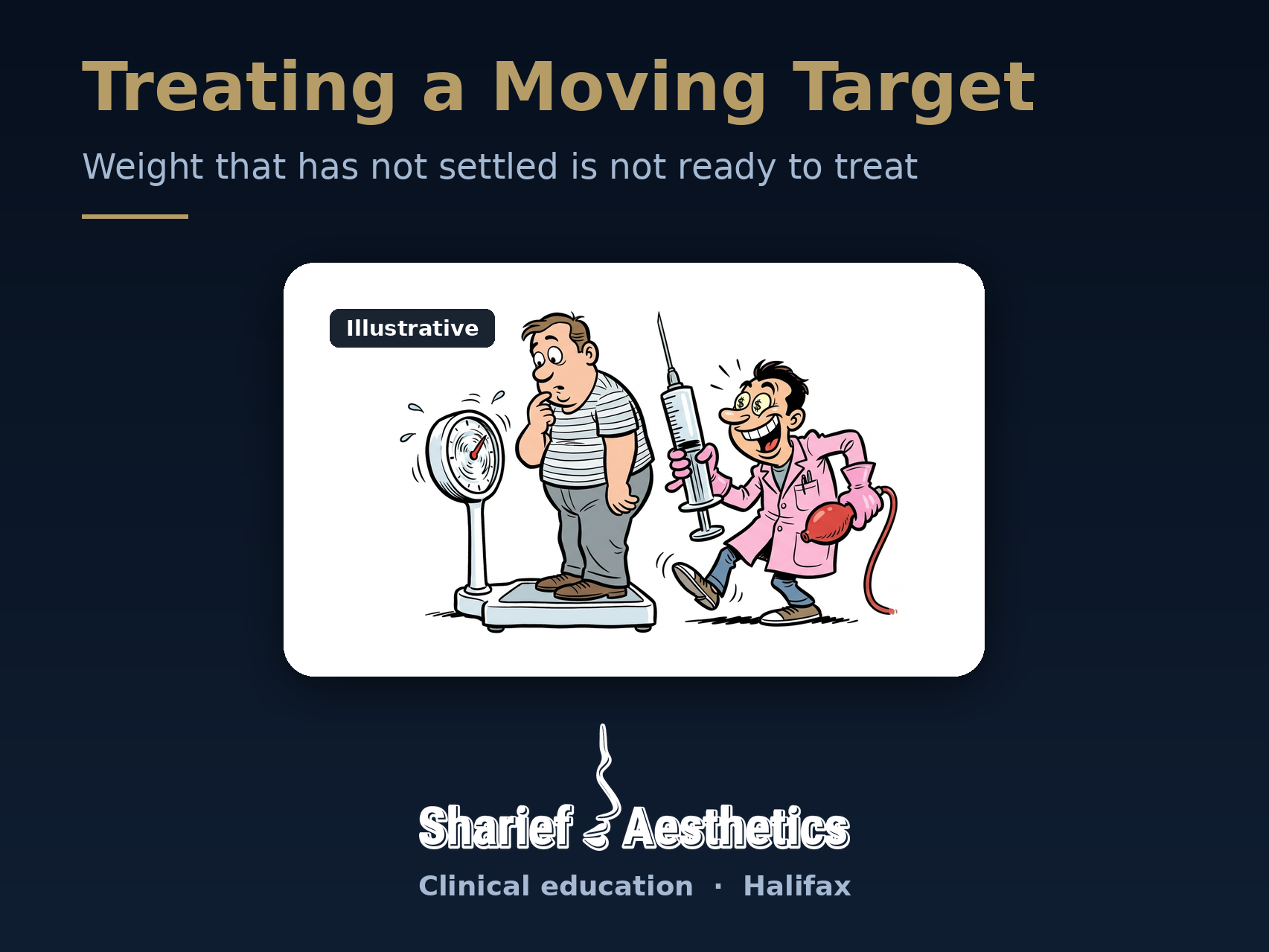
What is actually happening when the volume goes
Patients tend to describe it as fat loss, because that is the visible story. The tissue reality is layered and a little more interesting than that.
A 2026 review in Dermatologic Surgery examining facial change after medical weight loss described several structures moving at once. The superficial fat compartments deflate. The deeper support that props those compartments up is reduced. There is skeletal remodelling underneath. And the skin that was draped over all of it becomes laxer, because collagen and elastin do not retract at the speed that fat disappears.
This is why the mirror reads the change as ageing rather than slimming. It is not only that something is missing. It is that the scaffolding underneath has softened and the covering no longer fits the frame it was made for.
The same sequence happens below the neck. Fat leaves, the skin that was stretched over it has nowhere to go, and the contour changes. Arms, inner thighs, abdomen, and yes, the part of you that you sit on. It deserves the same patience as your cheekbones and generally receives considerably less of it.
You are not broken, and this is not a complication
Figures reported through 2026 suggest that among patients on GLP-1 medications, roughly six in ten notice midface volume loss and about half notice skin laxity. That is not a rare adverse event. That is what substantial weight loss looks like on a human face.
Worth saying plainly, because a great deal of the content aimed at you is designed to make a predictable physiological change feel like a defect that has happened to you personally.
What social media has branded as Ozempic face is simply what rapid, substantial weight loss looks like on human anatomy.
The part nobody is selling you
There is a whole conversation upstream of any injectable, and it gets very little airtime, largely because there is no product attached to it.
Body composition substudies of the major weight loss medications found that a meaningful proportion of total weight lost came from lean tissue rather than fat. That proportion is not unique to these drugs. It is what rapid weight loss does regardless of the method. What is different now is the scale and the speed, so the absolute amount is larger and more visible.
Three things influence how much of that you keep, and all three are within your control before anyone comes near you with a needle.
Protein intake. Published guidance during active weight loss sits in the range of 1.2 to 1.6 grams per kilogram of body weight per day, with older adults often at the upper end. Appetite suppression makes this genuinely difficult, which is exactly why it needs to be planned rather than left to chance.
Resistance training. Pooled trial data in adults undergoing caloric restriction found that resistance training preserved most lean mass. This does not require a gym membership or a training philosophy. It requires a regular mechanical signal telling the body that the muscle is still needed.
The rate of loss itself. Prescribing guidance has shifted toward the lowest effective dose and slower titration, with some clinicians holding escalation when loss exceeds roughly 1.5 kilograms per week. Faster is not better when the cost is muscle and skin quality.
These conversations belong with the physician managing your weight loss. Raise them early. They are considerably harder to apply retroactively.
The question I ask before I treat anyone
Before any filler or energy-based treatment in this clinic, one question comes first, and it has nothing to do with what you want done.
How stable is your weight, and has it moved more than five pounds recently for a smaller frame, or ten for a larger one?
If the honest answer is that it is still moving, then the honest recommendation is to wait.
This is not caution for its own sake. It is written into how these products are studied. Clinical trials of hyaluronic acid fillers routinely screen for participants whose weight has not fluctuated in the previous six months and who agree to keep it stable throughout. The manufacturers understand that a shifting canvas produces an unreliable result, which is why they design that variable out of their own evidence.
The mechanism of failure runs in both directions. Treat a face that is still losing, and the correction that looked right in month three looks insufficient by month nine, so more product goes in. Treat a face at its thinnest and then regain, and the same product now reads as heavy and unnatural. Either way the patient concludes that something went wrong with the treatment, when what actually happened is that they were treated during a process that had not finished.
Current consensus timing is to wait until weight has been stable for at least three to six months, which for many people on these medications lands somewhere between twelve and eighteen months after starting.
Why the rush is expensive in more ways than one
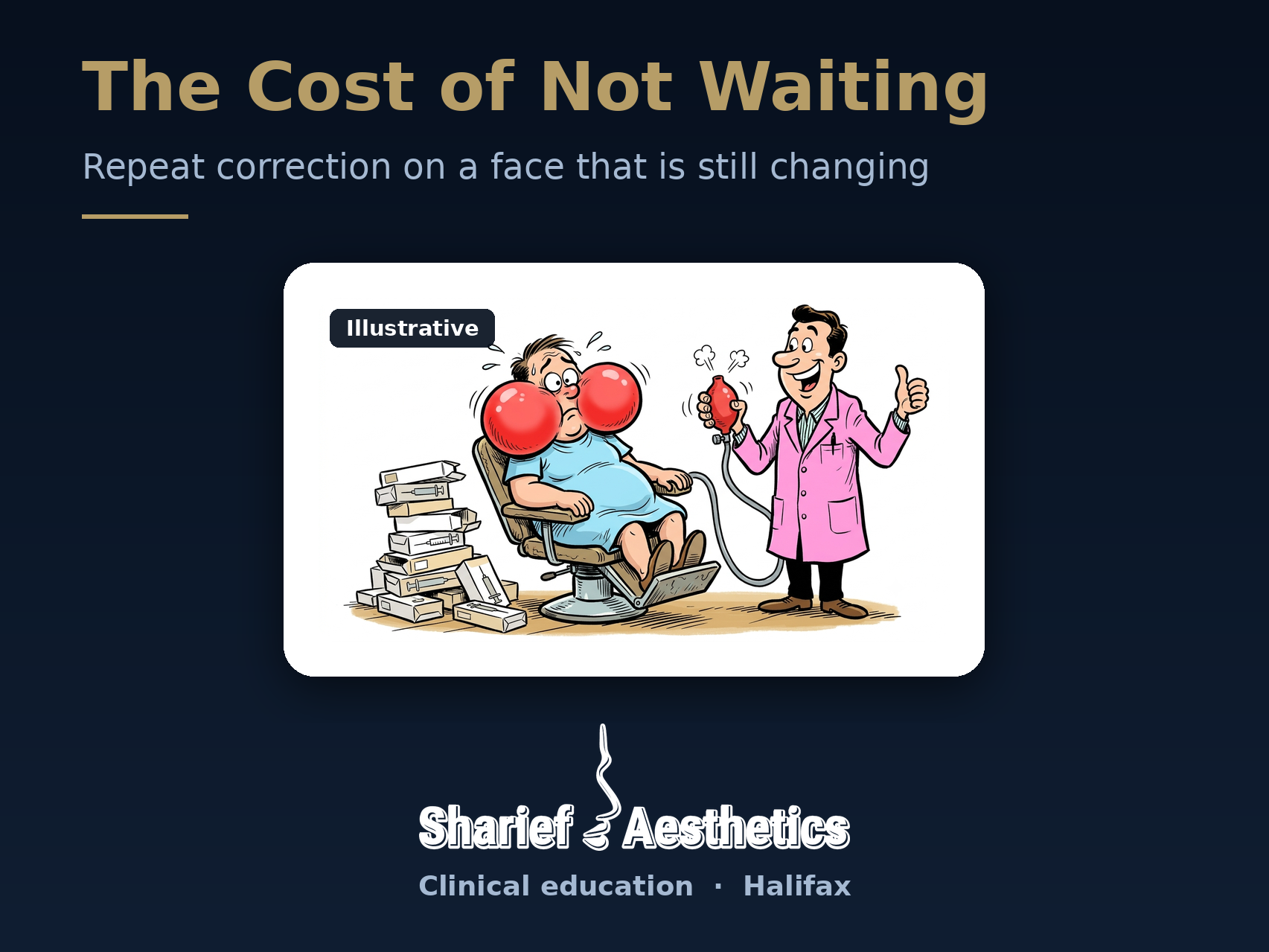
Treating early does not simply delay a good result. It sets up a cycle. Each adjustment costs money, carries its own risk profile, and adds product to a face that is still changing underneath it. Over a year or two of chasing a moving target, some patients accumulate considerably more filler than they would ever have needed had they waited and been treated once, properly.
The financial side of this deserves its own honesty. A single well-timed treatment on a stable face is not only the better clinical outcome, it is usually the cheaper one.
When you are genuinely ready
Once weight is stable, the plan should follow the anatomy rather than the trend.
Consensus guidance published in early 2026 moved toward prioritising collagen-stimulating treatments over pure volume replacement in medication-related weight loss, on the reasoning that the underlying problem includes lost structural support and not only lost bulk. Hyaluronic acid fillers remain useful, are reversible, and are often the right starting point where a specific hollow needs addressing.
Skin laxity is a separate problem and is not solved by adding volume beneath it. Energy-based approaches such as radiofrequency microneedling target tissue quality rather than contour, and the distinction between the two is explained in Microneedling vs. RF Microneedling.
Individual response varies considerably. Some patients need very little. Some need a staged plan over a year. Some need nothing at all once their weight settles and their face finds its own equilibrium, which happens more often than the internet would have you believe.
What patients actually want
One observation from the recent literature stayed with me, because it matches what I hear across the consultation desk. Patients in this situation do not want to look filled. They want to look like themselves again.
Those are different objectives, and only one of them is achieved by treating early and treating often.
The short version
1. Protect what you have while you are losing it. Protein in the range of 1.2 to 1.6 grams per kilogram per day, resistance training two or three times a week, and a rate of loss that is not faster than it needs to be. This is a conversation with the physician managing your weight loss, and it is worth having early.
2. Let your weight settle before anyone treats you. Three to six months of genuine stability. If it is still moving more than about five pounds for a smaller frame or ten for a larger one, you are not ready yet, and treating you would mean treating a moving target.
3. Then ask, and ask someone willing to tell you no. A physician who is comfortable saying not yet is worth considerably more to you than one who is comfortable booking you today. On that particular affliction, see The Truth About Refractory Integrity Syndrome.
Not yet is a real answer. It is frequently the correct one, and it is almost never the profitable one.
This article reflects the clinical opinion of the author, informed by current evidence. It is general education and not a substitute for individual medical assessment.
We educate. What you do with it is your decision, informed and your own.
Clinical education. Sharief Aesthetics, Halifax.