The Truth About Brown Spots: Which Ones Are Harmless, and Which Ones Need a Doctor
Those brown spots didn't show up this summer
Every year at the end of summer, patients point to the backs of their hands, their cheeks, or their chest and ask where these brown spots came from. The reality is that they've been forming for years. Sun damage builds up slowly, and a summer of it is usually what finally makes the older damage easy to see. The sun is the biggest reason skin looks older than it is, and these spots are one of the clearest signs of it.
Most of these spots are harmless. But not every brown patch is the same thing, and a few of the lookalikes are not harmless at all. So before anything is treated, the real first question is simple: what are you actually looking at?
What a sun spot actually is
Real sun spots have a medical name: solar lentigines. People also call them age spots or liver spots, though they have nothing to do with the liver. They form when years of sunlight push the pigment-making cells in one patch of skin into overdrive. You're left with a flat, clearly outlined brown mark where extra pigment has built up near the surface. Freckles and general uneven tone come from the same thing: pigment laid down by light.
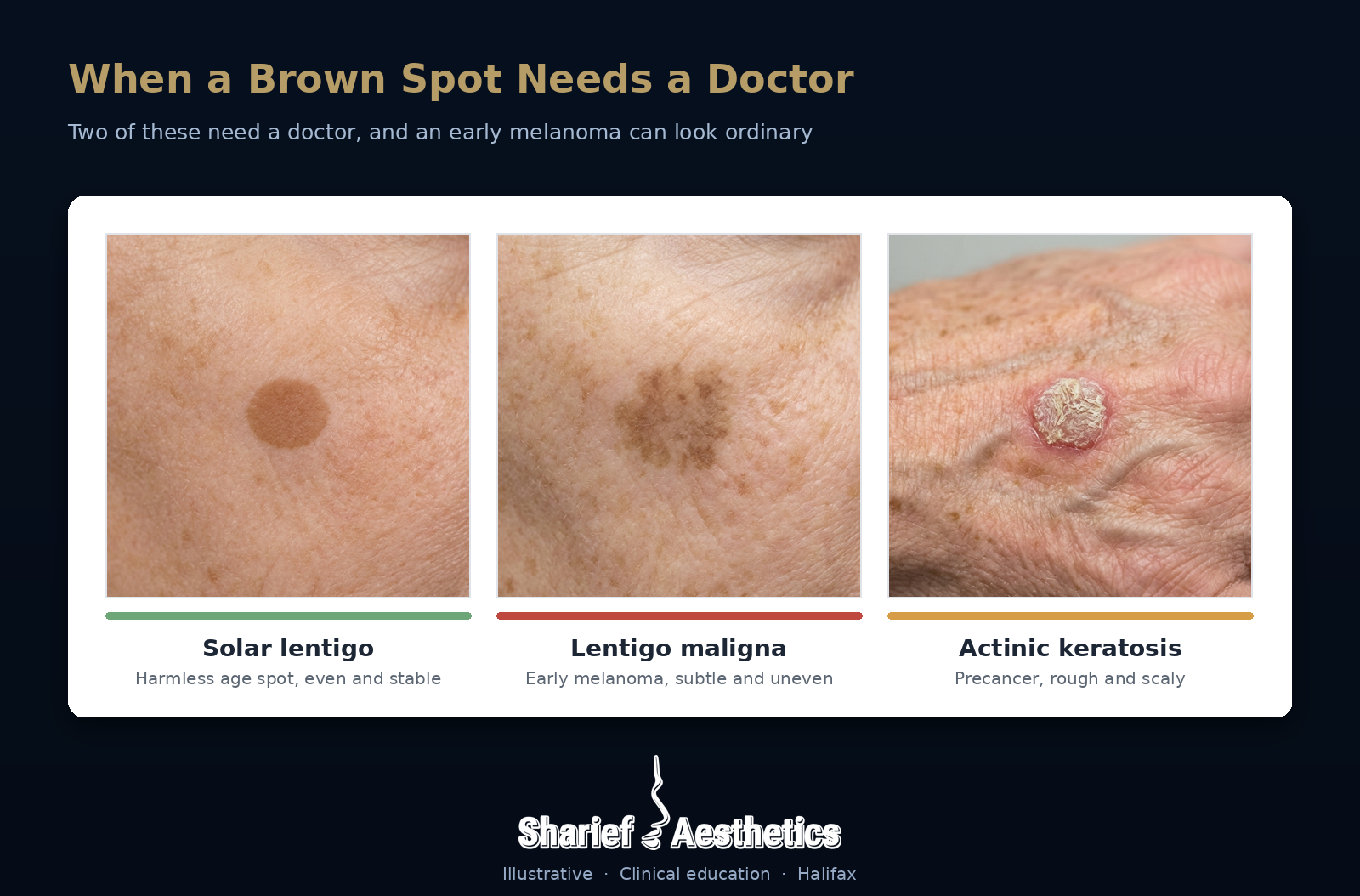
This kind of spot is flat, smooth to the touch, an even shade of tan or brown, and it stays the same over time. Run a finger over it and you feel nothing different from the skin around it. It is harmless. That is the spot that can be safely treated, and we will come back to how. But first, the lookalikes, because telling them apart is the part that actually matters.
Not every brown spot is a sun spot
"Brown spot" is not one thing. Several different lesions show up as brown marks, and they behave nothing alike. One is harmless. One can turn into cancer. One is harmless but isn't really a sun spot at all. And one is a cancer wearing the disguise of an ordinary spot. Telling them apart is the whole reason a trained professional should look before anything is treated.
Start with the one that looks most like sun damage: melasma. It also shows up as brown patches on the face, and it can look almost identical. But it is a different condition, driven by hormones and genetics, and it reacts badly to heat and light. That matters, because the same light that clears a sun spot can make melasma worse and bring the pigment back darker than before. Someone who assumes their melasma is "just sun damage" and has it treated can end up worse than they started. It cannot be sorted out in the mirror, and it is why I wrote a separate piece on how melasma is so often mishandled: The Truth About Melasma Treatment.
Then there is the rough one. People assume that if a spot is a little raised or scaly, they can scrub it off or have it lasered away. That is the dangerous assumption. A rough, dry, scaly patch, often pink, sometimes tender, usually on the face, scalp, ears or hands, is a different lesion called a solar or actinic keratosis. You can often feel it before you can clearly see it. It is precancerous, and left alone, a portion of these can turn into a skin cancer. It does not belong under a cosmetic laser. It needs a proper assessment.
There is also a raised brown growth that gets mistaken for a sun spot or a mole. A seborrheic keratosis sits up off the skin with a waxy, stuck-on look, almost like a small blob of dried candle wax. It is harmless, but it is a different lesion that needs different treatment, not pigment-targeting light.

And then the one that matters most. Many people believe that if a spot is flat, it must be safe. The opposite can be true. A melanoma, the most serious skin cancer, is often flat and pigmented, and on sun-damaged skin it can look like an ordinary brown patch. Flat is exactly its disguise. The warning signs are worth knowing in plain terms: a spot that is lopsided in shape, has a ragged or blurred edge, shows more than one colour, is wider than a pencil eraser, or is new or changing in any way. Any of those is a reason to have it looked at, not lasered.
There is another disguise, and it's the quietest one. The dangerous lesions don't always look alarming when they start. Some begin as a small, firm, harmless-looking bump, the kind people brush off as a milia or a blocked pore and ignore for years. (I walk through those benign bumps, and the few that aren't, in Decoding Facial Bumps.) What matters isn't how innocent it looked on the first day. It's whether it stays put. A small bump that slowly grows or changes, however harmless it seemed at first, has earned a proper look.
And it is not only pigment that signals trouble. A spot that keeps bleeding, scabs over and breaks open again, or simply never fully heals is its own warning, whatever its colour. A sore that will not settle is not a cosmetic problem, and it is never something to laser. It is a reason to be seen.
So it comes down to one decision, not a diagnosis: is this a spot to treat, or a spot to have a professional look at first? A flat, evenly coloured, unchanging spot is very likely the harmless kind. Anything thick, pink or scaly, any pigment that looks irregular or is changing, or any sore that won't heal, is a reason to pause and have it assessed. This is meant to help you know when to ask, not to diagnose yourself. Even experienced physicians confirm these with a proper examination, and sometimes a small biopsy, because the harmless lookalikes and the dangerous ones can sit very close together. Only a trained professional can properly tell them apart. None of this is meant to alarm you. The large majority of brown spots are exactly the harmless sun damage they appear to be. The point is simply knowing which ones can be treated, and which ones deserve the right set of eyes first.
For the harmless ones, what treatment actually does
When a spot is confirmed as a benign solar lentigo, it can be cleared with intense pulsed light. We use Lumecca, the IPL handpiece on our second-generation InMode Optimas MAX. The light is tuned so the pigment absorbs it while the skin around it is largely left alone. In the days after, the treated spots darken first, take on a fine "coffee-ground" speckle, then flake away as the skin renews. It can look worse before it looks better, and scattered sun damage usually takes a few sessions rather than one.
This is real medical equipment, not a beauty gadget. Turned up carelessly, IPL can burn, blister and bruise, which is exactly why it belongs in trained hands. The skill is not in using all the power but in using the right amount, dialed to your skin and watched closely during the session. Knowledge plus power: the power is the tool, the knowledge is what aims it and holds it back. Power without the knowledge behind it is just risk.
A few practical notes if a spot is benign and you choose to treat it. IPL suits lighter, untanned skin most predictably, while darker or recently sun-exposed skin needs more caution, which is part of what the assessment sorts out. Light and sun don't mix before or after, so the lower-sun months of fall and winter are the sensible window. And good daily sunscreen is what keeps new spots from forming in the first place, which I cover in Medical-Grade Skincare.
The bottom line
"A brown spot on the face" is a description, not a diagnosis. The large majority are harmless sun damage, and those can be treated well. But the only way to know which spot is which is to have it properly looked at. The same Lumecca platform also treats the redness and visible vessels of rosacea, which I cover in Lumecca IPL: The Clinical Truth About Rosacea and Vascular Repair. Same device, different target.
So the real next step isn't a treatment, it's a skin assessment. It does two things at once: it confirms whether a spot is the benign kind that can be safely treated, and it puts a trained eye on anything that looks off, including the rare lesion that belongs in a doctor's hands rather than under a laser. To have your skin properly assessed, call the clinic or book a consultation.